This Blog still building

This Blog still building

This Blog still building

This Blog still building.

This Blog still building

Sabtu, 09 Maret 2013

Peter Jones


Peter Jones, CBE (born 18 March 1966) is a British entrepreneur and businessman with interests in mobile phones, television, media, leisure and property. He became a television celebrity through his appearances on the BBC Two show Dragons' Den and on his American television show American Inventor. He was appointed Commander of the Order of the British Empire (CBE) in the 2009 New Year Honours

Businesses

His second venture was a computer business where he manufactured PCs under his own brand. In his mid twenties, he opened a cocktail bar in Windsor based on the Tom Cruise film Cocktail. However, he lost £200,000 after deciding to sell it. According to an interview with The Times, Jones's computer business failed when he was in his twenties, and he was forced to give up his three-bedroom home in Bray, his cars, and had to move back in with his parents.[3] He then joined Siemens Nixdorf.[4]
After Siemens, he set up his next venture Phones International Group in April 1998.[5] He started humbly by sleeping on the office floor but business soon grew. The firm experienced explosive growth with revenue totalling £14 million by the end of the first year and £44 million by the end of the second. The company was one of the fastest growing businesses in Europe. Group turnover for 2005/2006 was in excess of £150 million.[citation needed]
In the summer of 2005, Jones teamed up with another Dragons' Den star, Theo Paphitis, to buy the gift experience company Red Letter Days from fellow panellist Rachel Elnaugh, under whose ownership it had collapsed.
He has also created other businesses between 2004 and 2008, including firms such as Wines4Business.com, an online retailer specialising in the sale of wine and champagne to corporate clients and Celsius, a specialist recruitment business.
His investments resulting from his appearances on Dragons' Den include Wonderland Magazine (a luxury lifestyle and culture magazine), Square Mile International (which provides data services for marinas and later sold to BT), The Generating Company (a contemporary circus company), Concentrate Design (which creates products to help pupils concentrate at school), iTeddy and Reggae Reggae Sauce.[6]
He owns a TV production company called Peter Jones TV, and his business portfolio also includes a range of property investments (his nine properties include a Portuguese villa that he bought from DJ Chris Evans[3] and a property in Beverly Hills, California).
In 2009 Peter Jones founded the Peter Jones Enterprise Academy (formally NEA) as a way to improve the entrepreneurial capabilities within the UK. The Peter Jones Enterprise Academy (PJEA) is a centre of excellence for enterprise and entrepreneurship and has several campuses throughout the UK including Amersham, Sheffield, Manchester and Oxford.
Peter Jones sold part of Phones International Group, Wireless Logic, for £38 million in 2011.[7][8][9] Phones International Group retains Data Select, the other part of the group

Copyright © 2013 : http://en.wikipedia.org/wiki/Peter_Jones_%28entrepreneur%29#Early_life

James Clark


Synopsis

James Clark was born on March 23, 1944, in Plainview, Texas. At Stanford, he developed a program called the Geometry Engine. He started Silicon Graphics Inc. in 1981 before quitting the company in 1994. The same day, he and Marc Andreessen agreed to launch Netscape. It was sold to America Online in 1999, but Clark had already started a new venture by then, Healtheon, which would soon merge with WebMD.

Early Life

From his poverty-stricken childhood in Texas, Jim Clark rose to become one of the most famous and successful high-tech entrepreneurs in the world. Born in 1944, Clark was a strong-willed boy with a rebellious streak that became more pronounced after his parents divorced when he was 14. His mother supported him and his two siblings on $225 a month (she now lives in a house bought with Netscape stock that her son gave her).
In high school, Clark ran into trouble for setting off a smoke bomb on the band bus, swearing at an English teacher, drinking and drag racing. By age 16, he'd had enough. He dropped out of school and joined the Navy. There, he got his high school equivalency degree, began learning about electronics, and made money on the side by loan-sharking cash to other recruits at interest rates of 40 percent.
After the Navy, Clark enrolled in the University of New Orleans and worked his way through college and graduate school at the University of Utah while supporting a wife and two daughters. After getting his Ph.D., he had trouble finding his feet. He tried teaching, then consulting, then teaching again, this time as an associate professor at Stanford University.

Entrepreneurial Success

At Stanford, he developed a program called the Geometry Engine which generated three-dimensional computer graphics. He left academia in 1981 to start Silicon Graphics Incorporated with $25,000 he borrowed from a friend. By 1986,the company had revenues of $40 million and had revolutionized the design process for everything from bridges and airplanes to special effects for movies, including Terminator 2 (1991) and Jurassic Park (1993).
As the company grew, shareholders brought in more conservative management who put the reigns on Clark's freewheeling style. Clark, rumored to have an explosive temper, felt stifled. In 1994, he quit the company and sold his stock.

Netscape

The same day he resigned, Clark sent an email to Marc Andreessen, a recent graduate of the University of Illinois who had developed a Web browser called Mosaic at a time when most people didn't know the Web existed. Clark and Andreessen agreed to launch a new company devoted to Web software, and Netscape was born. The company had a phenomenal impact, quickly dominating the fledgling browser market and scaring industry giant Microsoft into changing its corporate focus.
Netscape was sold to America Online in 1999, but Clark had already started a new venture by then, an online health information service for doctors. Called Healtheon, the company became the biggest IPO (Initial Public Offering) of the year in 1999. Early investor interest in the company indicated that Clark had successfully launched three major technology start-ups in less than two decades.

WebMD

In July of 1999, Clark merged Healtheon with WebMD, another successful online health forum. That same year he published an autobiography, Netscape Time: The Making of the Billion-Dollar Start-Up That Took on Microsoft, which offered a first-hand account of Netscape’s race to beat Microsoft for control of the Internet. The book also detailed how and why Clark instigated the ongoing governmental antitrust trial against Microsoft.

Copyright © 2013 : http://www.biography.com/people/james-clark

Donald John Trump

Early Life

Real estate developer, mogul. Born Donald John Trump, on June 14, 1946, in Queens, New York, the fourth of five children of Frederick C. and Mary MacLeod Trump. Frederick Trump was a builder and real estate developer who came to specialize in constructing and operating middle income apartments in the Queens, Staten Island, and Brooklyn. Donald Trump was an energetic, assertive child, and his parents sent him to the New York Military Academy at age 13, hoping the discipline of the school would channel his energy in a positive manner. Trump did well at the academy, both socially and academically, rising to be a star athlete and student leader by the time he graduated in 1964. He entered Fordham University and then transferred to the Wharton School of Finance at the University of Pennsylvania from which he graduated in 1968 with a degree in economics.

New York Real Estate Developer

Trump seems to have been strongly influenced by his father in his decision to make a career in real estate development, but the younger man's personal goals were much grander than those of his senior. As a student, Trump worked with his father during the summer and then joined his father's company, the Trump Organization, after graduation from college. He was able to finance an expansion of the company's holdings by convincing his father to be more liberal in the use of loans based on the equity in the Trump apartment complexes. However, the business was very competitive and profit margins were narrow. In 1971 Donald Trump moved his residence to Manhattan, where he became familiar with many influential people. Convinced of the economic opportunity in the city, Trump became involved in large building projects in Manhattan that would offer opportunities for earning high profits, utilizing attractive architectural design, and winning public recognition.
When the Pennsylvania Central Railroad entered bankruptcy, Trump was able to obtain an option on the railroad's yards on the west side of Manhattan. When initial plans for apartments proved unfeasible because of a poor economic climate, Trump promoted the property as the location of a city convention center, and the city government selected it over two other sites in 1978. Trump's offer to forego a fee if the center were named after his family, however, was turned down, along with his bid to build the complex, which was ultimately named for Senator Jacob Javits.
In 1974 Trump obtained an option on one of the Penn Central's hotels, the Commodore, which was unprofitable but in an excellent location adjacent to Grand Central Station.
The next year he signed a partnership agreement with the Hyatt Hotel Corporation, which did not have a large downtown hotel. Trump then worked out a complex deal with the city to win a 40-year tax abatement, arranged financing, and then completely renovated the building, constructing a striking new facade of reflective glass designed by architect Der Scutt. When the hotel, renamed the Grand Hyatt, opened in 1980, it was popular and an economic success,
making Donald Trump the city's best known and most controversial developer.

Expanding His Empire

Trump married Ivana Zelnickova Winklmayr, a New York fashion model who had been an alternate on the 1968 Czech Olympic Ski Team, in 1977. After the birth of the first of the couple's three children in 1978, Donald John Trump, Jr., Ivana Trump was named vice president in charge of design in the Trump Organization and played a major role in supervising the renovation of the Commodore.
In 1979 Trump leased a site on Fifth Avenue adjacent to the famous Tiffany & Company as the location for a monumental $200 million apartment-retail complex designed by Der Scutt. It was named Trump Tower when it opened in 1982. The 58-story building featured a 6-story atrium lined with pink marble and included an 80-foot waterfall. The luxurious building attracted well-known retail stores and celebrity renters and brought Trump national attention.
Meanwhile Trump was investigating the profitable casino gambling business, which was approved in New Jersey in 1977. In 1980 he was able to acquire a piece of property in Atlantic City. He brought in his younger brother Robert to head up the complex project of acquiring the land, winning a gambling license, and obtaining permits and financing. Holiday Inns Corporation, the parent company of Harrah's casino hotels, offered a partnership, and the $250 million complex opened in 1982 as Harrah's at Trump Plaza. Trump bought out Holiday Inns in 1986 and renamed the facility Trump Plaza Hotel and Casino. Trump also purchased a Hilton Hotels casino-hotel in Atlantic City when the corporation failed to obtain a gambling license and renamed the $320 million complex Trump's Castle. Later, while it was under construction, he was able to acquire the largest hotel-casino in the world, the Taj Mahal at Atlantic City, which opened in 1990.
Back in New York City, Donald Trump had purchased an apartment building and the adjacent Barbizon-Plaza Hotel in New York City, which faced Central Park, with plans to build a large condominium tower on the site. The tenants of the apartment building, however, who were protected by the city's rent control and rent stabilization programs, fought Trump's plans and won. Trump then renovated the Barbizon, renaming it Trump Parc. In 1985 Trump purchased 76 acres on the west side of Manhattan for $88 million to build a complex to be called Television City, which was to consist of a dozen skyscrapers, a mall, and a riverfront park. The huge development was to stress television production and feature the world's tallest building, but community opposition and a long city approval process delayed commencement of construction of the project.

In 1988 he acquired the Plaza Hotel for $407 million and spent $50 million refurbishing it under his wife Ivana's direction.

Ups and Downs of Business

Trump reached south to build a condominium project in West Palm Beach, Florida, and in 1989 he branched out to purchase the Eastern Air Lines Shuttle for $365 million, renaming it the Trump Shuttle. In January 1990, Trump flew to Los Angeles to unveil a plan to build a $1 billion commercial and residential project featuring a 125-story office building.
It was in 1990, however, that the real estate market declined, reducing the value of and income from Trump's empire; his own net worth plummeted from an estimated $1.7 billion to $500 million. The Trump Organization required a massive infusion of loans to keep it from collapsing, a situation which raised questions as to whether the corporation could survive bankruptcy. Some observers saw Trump's decline as symbolic of many of the business, economic, and social excesses that had arisen in the 1980s.
Yet, he climbed back from nearly $900 million in the red: Donald Trump was reported to be worth close to $2 billion in 1997.

Personal Life, Politics, and Reality TV

Donald Trump's image was tarnished by the publicity surrounding his controversial separation and the later divorce from his wife, Ivana. But he married again, this time to Marla Maples, a fledgling actress. The couple had a daughter two months before their marriage in 1993. He filed for a highly publicized divorce from Maples in 1997, which became final in June 1999. A prenuptial agreement allotted $2 million to Maples. In January 2005, Trump married for a third time in a highly publicized wedding to model Melania Knauss, who gave birth to a son, Barron William Trump, in March 2006; it was her first child and Trump's fifth.
On October 7, 1999, Trump announced the formation of an exploratory committee to inform his decision of whether or not he should seek the Reform Party's nomination for the presidential race of 2000.
A state appeals court ruled on August 3, 2000, that Trump had the right to finish an 856-foot-tall condominium. The Coalition for Responsible Development had sued the city, charging it was violating zoning laws by letting the building reach heights that towered over everything in the neighborhood. The city has since moved to revise its rules to prevent more such projects. The failure of Trump's opponents to obtain an injunction allowed him to continue construction.
In 2004 Trump began starring in the NBC reality series The Apprentice, which quickly became a hit. In later years the show began showcasing celebrities as contestants under the revised name The Celebrity Apprentice.
In 2012 Trump's flirtation with politics returned when he pubicly announced he was considering running for president again. However, his association with the "Birther" movement, a fringe group that staunchly believed President Barack Obama was not born in the United States, discredited his reputation politically to varying degree. Regardless, Trump has continued to be vocal against President Obama—not only regarding his place of birth—but also on a variety of his political policies.

Copyright © 2013 : http://www.biography.com/people/donald-trump

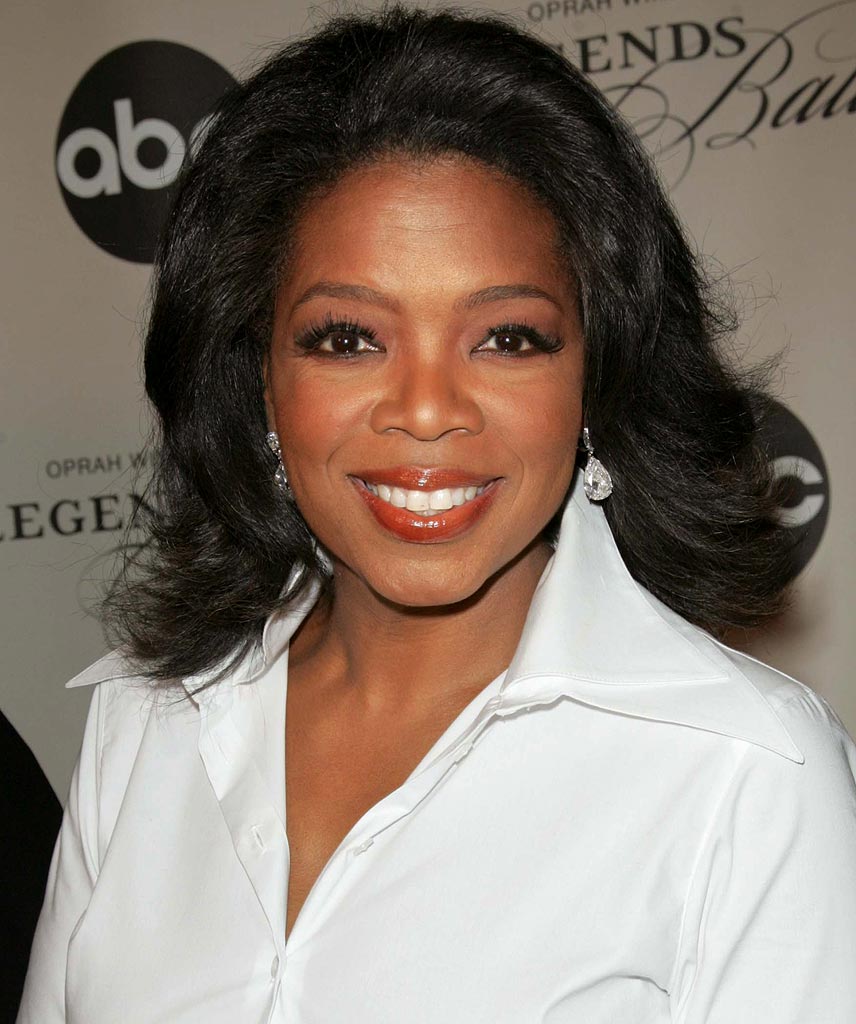
Oprah Winfrey


Oprah winfrey born on January 29, 1954, in Kosciusko, Miss., to Vernita Lee, a housekeeper, and Vernon Winfrey, a soldier. She was actually born Orpah Gail Winfrey, but mispronunciations and misspellings eventually won out and Orpah became Oprah.

Oprah spent her childhood struggling with a strange dichotomy: academic achievement and a dysfunctional home life. She lived with her grandmother until she was six, and, in that time, learned to read.
She then moved to Milwaukee with her mother. The two lived together in poverty. Her mother was less supportive of her growing intelligence, and she endured physical abuse by relatives. In the midst of it all, she skipped to grades and was awarded a scholarship at age 13.
Soon after, Oprah's mother shipped Oprah off to her father in Nashville. Vernon made education a priority and pushed Oprah to succeed. She became an honors student, won a full scholarship to Tennessee State University, and was crowned Miss Black Tennessee by age 18.

Oprah's First Job:

As soon as she became a student at Tennessee State, Oprah dived into broadcast media, working at a nearby Nashville radio station. She soon moved on to television, becoming the youngest news anchor and first African-American anchor at Nashville's WTVF.

The Early Years:

Oprah's first stint as a talk show host came after a move to Baltimore, Md., where she joined the news team at WJZ. She was quickly tapped to co-host the local show People Are Talking. This was her first step to much, much, much larger things.

Becoming a Talk Show Host:

Oprah's next career step took her from the shores of the Atlantic to the shores of Lake Michigan. She landed in Chicago, at WLS, taking over the low-rated morning show AM Chicago. Her style, personality, and ability to talk to people about real issues sent the little last-place show into first place in less than 12 months.
In a little over two years – between its debut in January 1984 and September 1986 – Oprah lead the program into national syndication, easily overtaking top-rated Donahue.

Key Moment in Her Career:

How do you pick just one?
There’s entering syndication in 1986 and quickly becoming No. 1 in a profession traditionally dominated by white males. There’s eschewing the "trash TV" format for a kinder, gentler and truly more informative style in the mid-90s, essentially signaling an end to the fad. There's co-founding the successful cable station Oxygen -- and later OWN, the Oprah Winfrey Network. There's inking a deal that will see Oprah celebrate her 25th season in 2011.
And so much more.

What Does the Future Hold?:

Oprah is a producer, publisher, book critic, actress, and international celebrity. She is, perhaps, a living media brand - one that seems to turn to gold whatever it is she deems worthy to touch. It's hard to imagine that her career could grow much larger than it is. But with fans petitioning to nominate her for a Nobel Peace Prize – well, the sky's the limit.
On top of it all, Oprah remains a down-to-earth and easy to talk to woman. And, truly, that's what has made her a success.

And Just for Fun:

  • The name of Oprah's production company, Harpo Productions, is "Oprah" spelled backward.
  • Oprah received an Academy Award nomination for her role in Steven Spielberg's The Color Purple. She would later produce a version of the film on Broadway.
  • Oprah publishes two magazines, O, The Oprah Magazine and O at Home. Fortune magazine named O, The Oprah Magazine the most successful publishing start-up in history.
  • Oprah will even launch a signature radio channel on the XM satellite network.
  • On her 2004 season premiere, Oprah gave new cars to everyone in her audience.
  • Oprah is the voice of Gussy the Goose in the 2006 adaptation of Charlotte’s Web.
  • She once dated critic Roger Ebert.
  • Winfrey is listed by Forbes International as the world's only African-American billionaire.
  • Oprah donates more to charity than any other show business celebrity. Listed as the 235th richest American (in 2005), she was the 32nd most philanthropic.
  • Since beginning "Oprah's Book Club," the television-based literary society is so powerful that any book placed on the must-read list becomes an instant best seller. (After it was discovered that author James Frey’s memoir A Million Little Pieces was full of untruths, Oprah chastised the writer on her program, essentially revoking its "Book Club" status. Stung by the experience, she promoted classics for some time afterward.)

Copyright © 2013 : http://talkshows.about.com/od/oprahwinfrey/p/BioOprah.htm

Adolf Dassler


When the starting shot rang out, the athletes surged forward. Jesse Owens dug his spikes deep into the racing track of Berlin's Olympic Stadium -- and the best sprinter of his day dominated the 100 meters race to win a gold medal at the 1936 Olympic Games. America's black superstar took home a total of four gold medals. And each of his victories represented minor triumphs for two German brothers as well -- Adolf ("Adi") and Rudolf Dassler -- the manufacturers of the sprinting shoes that carried the sprinter of the century from victory to victory.

 Of course, success did not come as a total surprise. Herzogenaurach, the Dasslers' home town in Bavaria, has a long tradition as a center for shoemaking. In 1922, for example, it boasted 112 shoemakers drawn from a population of 3,500. It was here, in 1924, that Adolf and Rudolf Dassler founded the "Dassler Brothers Shoe Factory" to specialize in athletic shoes. During the 1932 Olympic Games in Los Angeles, a German sprinter wearing Dassler spikes took the bronze medal. But it was the legendary shoes of Owens that established the Dasslers' worldwide reputation and laid the foundation for two exceptional careers. After the war, Adi and Rudolf went their separate ways. Each would build up one of West Germany's showpiece sports companies -- one Adidas, the other Puma.
But the history of the Dasslers -- who both joined the Nazi Party in 1933 -- wouldn't be complete without one chapter from World War II: In 1944, there was suddenly a spike in the number of Allied tanks being blown apart by German fire. The culprit was the latest anti-tank rocket launcher, nicknamed the "Panzerschreck" ("Tank Terror"). This extremely effective weapon petrified Allied tank crews -- and it was
 manufactured in the same factory that had developed Owens' shoes only eight years earlier.
 
Welding Replaces Stitching
This little-known excursion into the war industry by the two famous shoemakers was hardly an isolated case. Hitler's regime used many small and medium-sized companies to produce military equipment and armaments. "For the 'total war' proclaimed by Goebbels in early 1943, the Nazis needed a total war economy," explains Lutz Budrass, a business historian at the University of Bochum.
Similar things were happening all across the country -- and German industry increasingly resembled one big military machine. The Hugo Boss textile factory, for example, in the southern German town of Metzingen, was also a military supplier. Beginning in late 1944, instead of suits and leather jackets, workers on the production floors of the future fashion czar were making ball bearings. Germany's flagship airline Lufthansa manufactured radar equipment for the Luftwaffe, Germany's air force, and furniture companies made parts for fighter jets like the Heinkel He 162, one of the first military jets in the world. Given the scarcity of metal, the jet was primarily made of wood.
Four years into World War II, not much Olympic glory was left among the shoemakers of Herzogenaurach. The German army was on the retreat on virtually all fronts, bombs were raining down on German cities and resources were running short. December 1943 marked the final blow for the town's shoe production. Hitler's regime ordered a halt to all civilian business operations, and the shoe-making machines in the Dassler Brothers' production hall were replaced with spot-welding equipment for making weapons. Before long, nearly everyone in Herzogenaurach was working for the military. The local lederhosen factory stopped making the traditional Bavarian leather shorts and, instead, started producing bread bags and rucksacks for soldiers. A nearby family business made torpedo parts for the navy.
 
A Completely Militarized Industrial Landscape
The German army fashioned the Dasslers' Panzerschreck after the American bazooka: a shoulder-fired steel tube; weight 9.3 kilograms (20.5 lbs); length 164 centimeters (5.4 feet); with a range of up to 180 meters (590 feet). A rocket fired from the Panzerschreck could penetrate steel armor 20 centimeters (8 inches) thick.
Responsibility for actually producing the new weapon lay with the military contractor Schricker & Co., located in the nearby town of Vach. But given the increasingly devastating British and American air raids on German cities, Schricker decided to transfer assembly operations to Herzogenaurach. Freight cars filled with parts for the "Stove Pipe" -- as the Panzerschreck was popularly called on account of its simple construction -- came to Dassler by rail.
Inside the plant, shoe seamstresses -- who had quickly been given makeshift training to work in the armaments industry -- welded sights and blast shields onto the pipes. French forced laborers were also on the production line. "The construction of the Panzerschreck was so simple that, given a little practice, even unskilled workers had hardly any problems manufacturing it," one former employee told local historian Manfred Welker. But even with the simple design, German army inspectors still found themselves discarding many of the weapons made by Herzogenaurach's amateurs on account of their flaws. The complicated and dangerous production of the rockets, though, continued to be handled by the professionals in Vach.
 
An Answer to the Tank, Too Late
On the front, German soldiers eagerly awaited the Dassler weapon. Despite its exceedingly simple design, it was still remarkably effective. "The Panzerschreck represented a quantum leap for the infantry in terms of anti-tank defense," explains Christian Hartmann, a military historian at the Munich-based Institute of Contemporary History (IfZ). "It was the first weapon that German infantrymen fighting on their own could use to destroy tanks from a distance."
In view of the rapidly advancing Allied armies, which were vastly superior in terms of sheer numbers, the Nazis increasingly propagated the idea that anyone could knock out tanks using only the Panzerschreck or its little brother, the single-use "Panzerfaust" ("Tank Fist"). An illustrated field booklet entitled "Der Panzerknacker" ("The Tank Buster"), for example, included awkward rhythms meant to help German soldiers recognize and combat enemy tanks, such as: "Notice first the fine design / sloping armor and curving line / five road wheels, study it well / that's the T-34, and that's how you tell."
Wherever the specially trained "tank-destroying detachments" made an appearance, there was a significant increase in the number of enemy tanks knocked out. In March 1945, there were some 92,000 Panzerschrecks being used on the crumbling fronts. But the weapons had arrived too late to have a major influence on the war's outcome. It wasn't until 1944 that Panzerschrecks and Panzerfausts could be deployed on a large scale, but by then the military's initial good fortune had long since run out. "If large numbers of Panzerschrecks could have been deployed during the Russian campaign in 1941, Moscow would have probably fallen," says Hartmann. As it turned out, the "stove pipe" was just one of many newly developed weapons that, at best, postponed the collapse of the fronts -- and thereby only prolonged the horror of the war.
 
A Stroke of American Luck
The Dasslers' brief career as weapons manufacturers nearly proved their undoing. In April 1945, when the Americans marched into Herzogenaurach, US tanks pulled up in front of the factory. The soldiers were still debating whether they should destroy the building when Adi's wife, Käthe, walked out and charmingly convinced the GIs that the company and its employees were only interested in manufacturing sports shoes. What's more, after the factory was saved, the occupying forces turned out to be a blessing for the two shoemakers. The US Air Force set up its own operations at the former military air base in Herzogenaurach. When the sports-crazy Americans got wind of the fact that the Dassler brothers had produced the shoes that Jesse Owens had run in, they started buying all the products the company could produce. Large orders for footwear for basketball and baseball (and hockey) soon rolled in and gave the company its first boost on the road to becoming a worldwide success story.
The dark chapter as a wartime weapons manufacturer was quickly forgotten at the successor companies, Adidas and Puma. Today, both firms are corporations owned by investors spread across the world. In the quiet community of Herzogenaurach, though, it was a legacy that would be felt for many years to come -- and seen, in the pipes put to use all over town as gutters and fence posts rather than as the Panzerschrecks they had originally been meant fo

Copyright © 2013 : http://www.spiegel.de/international/germany/shoes-and-nazi-bazookas-the-prehistory-of-adidas-and-puma-a-611400.html

Jumat, 08 Maret 2013

Duncan Bannatyne

Biography
Born in 1949 in the town of Clydebank, Duncan was raised in relatively modest circumstances. He was told by his mother that she could not afford to buy him a bicycle, so Duncan asked the local newsagents if he could start a paper round; told he would need a list of 100 potential customers, Duncan painstakingly knocked on many doors and eventually drew up a list of 100 names and addresses. He got the job, bought a bike and never looked back.
In 1964, at the age of 15, Duncan volunteered for 12 years with the Royal Navy as a junior 2nd class engineering mechanic stoker at RNTE Shotley near Ipswich. He served in the Navy for several years before receiving a dishonourable discharge for threatening to throw an officer off a boat landing jetty in Scotland.
In his biography, Duncan explains the incident; it was in part a reaction to this officer's abuse of his authority, in part a dare by his shipmates and in part a way of getting out of the Navy, with which he had become disillusioned. Afterwards, he had to serve nine months in the tough Colchester military detention centre before being discharged aged 20.
In his twenties, Duncan moved to Jersey, where he met his first wife, and then to Stockton-on-Tees in the North East. It was there that Duncan’s business career began, with an ice cream van bought for £450; he soon expanded by buying more vans and eventually sold the business for £28,000, founding a care home business instead. Quality Care Homes was sold for £26 million in 1996 and another business, children’s nursery chain Just Learning, for £22 million.
Duncan has since branched into Health Clubs, with the popular Bannatyne's Health Clubs chain to his name, and also bars, hotels and property. He acquired 26 Health Clubs from Hilton Hotels back in August 2006, which made Bannatyne's the largest independent chain of Health Clubs in the United Kingdom.
In October 2008, in defiance of the credit, crunch he opened the £12,000,000 Bannatyne Spa Hotel in Hastings and also revamped his spa chain.


Television and media career
Duncan’s first TV appearance was in October 2003, on the BBC Two documentary Mind of a Millionaire. He went on to present 23 episodes of Mind Your Own Business, again for the BBC, where he helped to transform failing businesses. Since his initial appearance on BBC Two's Dragons' Den, Duncan has become a very familiar face in the media.
He has appeared on ITV's Fortune - Million Pound Giveaway and made guest appearances in episodes of Would I Lie To You?, 8 out of 10 Cats, Al Murray's Happy Hour, The Graham Norton Show, one episode of Break with the Boss, as well as several appearances as a panelist on channel Five's The Wright Stuff. He also appeared on ITV1's Rich List Give It Away, where he travelled the country encouraging wealthy people to give money to charity.
A documentary entitled Bannatyne Takes on Tobacco was broadcast on BBC2 on 1 July 2008. In this programme Duncan visited three African countries to investigate the tactics used by big tobacco companies (British American Tobacco in particular) in selling cigarettes to children. So successful and far reaching was the documentary that the Maldives Government, having watched it, overturned a decision to co-operate with BAT who wanted to bring a certain cigarette brand into their territory.

Charity work
As a fervent fundraiser Duncan supports a number of key charities including the United Nations Children’s Fund (UNICEF) and Scottish International Relief (SIR). Earlier this year Duncan was named as a UNICEF UK Ambassador which was a great honour.
Duncan’s charity work is far reaching and through his charity work with SIR he has been involved in several projects in Romania & Colombia over a period of 10 years, notably Casa Bannatyne in Târgu-Mures, a hospice founded by Duncan for orphans with HIV and AIDS.
In March 2008, Duncan established the Bannatyne Charitable Trust with a personal injection of £1,000,000 and in May of the same year he added his support to the launch of the Geared for Giving Campaign at the House of Commons, to encourage UK Business Leaders to set up and promote a Workplace Giving scheme to benefit UK registered charities with tax effective donations through employees pay.
Duncan became President of No Smoking Day in October 2008 and has also been involved with the stop smoking charity QUIT, visiting schools and campaigning for awareness amongst children of the dangers of smoking.
Duncan is a trustee of Comic Relief and on the 27th November 2008 he travelled to Ethiopia to visit some of the charity’s projects. He said “The most significant part for me was when we were shown that people are taught how to sow vegetables so they can grow them in their own homes; in addition to the training programme, the project supplies seeds and tools so that they can become self sufficient.” Duncan then visited a woman had gone through the programme and was now growing her own plants ready for sale. Her whole garden was taken up by an amazing array of plants. Duncan presented her with the Bannatyne/Ethiopia award for best entrepreneur of the year.


Personal life
Duncan has six children, four by his first wife and two by his current wife, Joanne McCue. He also has one grandchild, from his eldest daughter.
Joanne McCue was Duncan's former Director of Nursing with Quality Care Homes. He proposed to her in Barbados in early 2006 and was married on 11th November 2006 at St Mary’s Church in Norton, Tees Valley. Celebrities at the ceremony included Anna Ryder Richardson, Cherie Lunghi, Gary McCausland, Dragons’ Den presenter Evan Davis and fellow Dragons Theo Paphitis, Richard Farleigh, Simon Woodroffe and Deborah Meaden. Pop star Marc Almond then performed for 200 guests in the warehouse next to his company's head office.
Duncan was awarded an honorary Doctorate of Science (D.Sc.) by Glasgow Caledonian University on 5th July 2006 for services to business and charity. He was also awarded a Doctorate of Business Administration (DBA) from the University of Teesside on 6th February 2009.
Duncan recently celebrated his 60th birthday at Murano’s in London with celebrities such as David Coulthard, James Caan, Theo Paphitis and Anna Ryder Richardson. A second party was held in the North East which was headlined by UK soul singer Beverley Knight and featured Chesney Hawkes. The celebration took place in a converted warehouse in Darlington, County Durham.

 Copyright © 2013 : http://www.bannatyne.co.uk/biog.asp

 
Top Blogs Business
blekning av tänder
Electricity Lightning Electricity Lightning